Spectatorship and Surveillance in Liberal Democracies: Seeing and Being Seen
Under contract with Oxford University Press
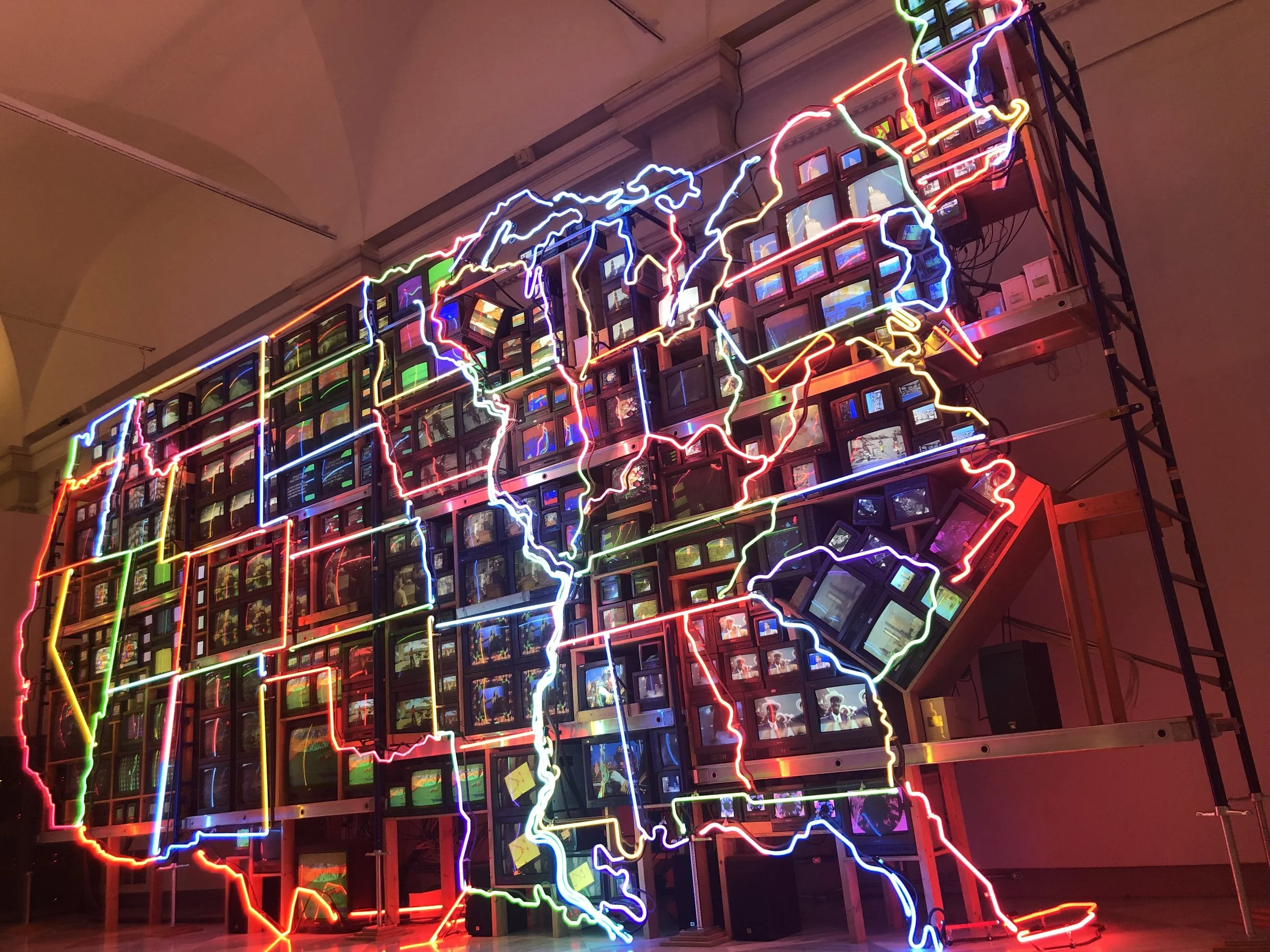
Nam June Paik’s Electronic Superhighway: Continental U.S., Alaska, Hawaii (1995), which consists of a fifty-one channel video installation depicting the each of the states and one closed-circuit television feed. The CCTV feed represents the District of Columbia, capturing viewers of the piece in the Smithsonian American Art Museum.
Pundits and scholars alike often blame today’s illiberal threats to democracy on a political culture that is uniquely emotional, theatrical, visual, and online. Democratic theorists describe our era as one of “audience democracy,” whereby the people primarily act as spectators of others vying for political power, rather than exercise it themselves. Yet they often neglect the structural conditions that situate the people as spectators rather than participants of formal politics. The people are spectators because they are also subject to surveillance—by each other, by private companies, and by the state. It is one thing to experience democracy like an audience watching politicians like actors on a stage; it is quite another thing entirely for this theatrical experience to take place from within a panopticon.
Spectatorship and Surveillance in Liberal Democracies draws on the history of modern political thought to interrogate the power exercised through observation and judgment. I argue people must be in control of their own publicity if we are to restore the democratic freedom lost in our digitized era. I return to the works of Thomas Hobbes, Jean-Jacques Rousseau, Adam Smith, and Jeremy Bentham to clarify what is lacking in our contemporary conversations: the problem is not that we like to watch but that material inequality and political actors shape who is seen with scrutiny or with sympathy. Drawing on original archival research of Bentham’s lesser known “Sotimion,” a residence to help unmarried women conceal their pregnancies to protect their social reputations while welcoming trusted visitors, I defend practices of privacy, pseudonymity, and secrecy under conditions of political, social, and economic inequality to meet the challenges of our digital age.